Components for sliding gates from fortamigo.com
Gate and fence components, operators, and infill
Choose components and kits for building a gate, gate and fence infill, or profiles for the frame. We also offer operators and installation instructions.
Gate kits and components
What we offer: build your own sliding gate






We serve everyone who wants to cantilever sliding gates and track sliding gates build themselves, or make gates for other people. We offer sliding gate components of high quality, with short delivery times and at a fair price.
Building a swing gate or pedestrian gate? Also check out components and operators for swing gates and pedestrian gates.
We supply customers with the components needed to build a gate, together with instructions so they can assemble, install and commission the gate with minimal experience themselves. We provide delivery and advice about your gate.
To make choosing easier, we have put together sliding gate component kits. We’ll be happy to help you choose. If you have a specific request, email [email protected].
Information about gate frames
Sliding gates
| Sliding gates are classified by their method of movement as follows: | |
| Cantilever sliding gates: |
the gate is supported above the ground by a C-profile that runs in load-bearing carriages |
|---|---|
| Track-mounted sliding gates: |
the gate has wheels fixed to its lower edge that run along a track |
| Suspended sliding gates: |
the gate has carriages at the top that run inside a C-profile fixed to the ceiling or wall |
The following illustrations give you an idea of the individual components of a sliding gate:
Cantilever sliding gate
Cantilever gates are popular thanks to their design, which allows maintenance-free operation and does not require level ground. The gate is supported approximately 5 to 10 cm above the ground by a C-profile, which is anchored outside the clear opening on two load-bearing carriages, firmly anchored in a concrete foundation. However, bear in mind that the gate needs more space to slide open—approximately 30 to 40% more than the clear opening width.
Layout of cantilever sliding gate components
|
Click a specific part of the image to view the product category. |
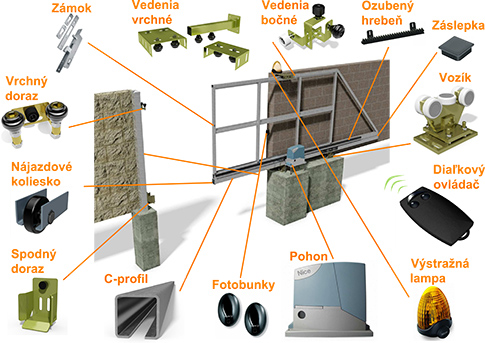
How a cantilever sliding gate works
The essential components of a cantilever gate are C-profile and the gate frame. Build the gate frame from closed-section, thin-walled steel profiles. A C-profile is welded to the bottom of the frame. This profile allows the gate to move horizontally on bearings incorporated into two support trolleys. The trolleys are anchored in concrete foundation. At the top of the gate, movement is stabilised by gate guide (top or side), which does not damage the gate's finish through friction. Gate stops are handled by bottom and top stops.
The C-profile is made from high-quality cold-rolled steel and does not expand. The trolley bearings are precision-fitted to the C-profile and protected from dirt by end caps. The support trolleys can be adjusted for height and pivot, ensuring that the bearings on the trolley are loaded evenly.
In most cases, an electromechanical operator together with safety devices (photocells, warning light). However, the gate can also be opened manually; in this case, it can be locked with a hook lock with a handle or pull handle. We offer our customers NICE operators because of our excellent experience with this brand.
Cantilever gate frame construction
The gate frame is made from closed-section steel profiles. Build the frame from 40 × 40 mm, 60 × 40 mm, 80 × 40 mm profiles, or other sizes depending on the gate's dimensions and weight. The overall load capacity of the gate frame depends on the material used to weld it together. As the size of the box sections used increases, so does the stiffness of the frame and therefore the load capacity of the gate infill.
Approximate calculation of the total length of a cantilever gate: Multiply the opening width by 1.4 and add 0.2 m (required for the gate guide). Example: the opening is 4 m wide. Calculation: 4 m × 1.4 + 0.2 m = 5.8 m (the total gate length is 5.8 m). This approximate calculation applies to gates weighing up to 600 kg; for heavier gates, the coefficient can be as high as 1.6, depending on the gate's weight. For heavier gates, the coefficient can be as high as 1.6, depending on the gate's weight.
If you are planning a lightweight construction, you can use a shorter gate overhang. As the gate's weight increases, it is better not to shorten the overhang; use a coefficient of at least 1.4 as a guide.
Gate frame infill
You can tailor the gate infill to suit the style of your fence or home (wooden slats, steel infill, plastic profiles, Lexan, expanded metal, etc.).
Related links cantilever gate
| More information: links |
|
|---|---|
|
Component kits for cantilever gates: For convenience, our range includes complete kits of the components needed to build a cantilever gate. The kits are available at discounted prices. |
|
|
Choosing components for a cantilever gate: Detailed information on choosing components for a cantilever gate. |
|
|
Recommended dimensions are provided in the guide Concrete foundation for a cantilever gate. |
|
|
Frequently asked questions when building a cantilever sliding gate. |
|
Track-mounted sliding gate
Track-mounted sliding gate (also called a ground-track gate) runs along a rail installed on a concrete foundation. Steel running wheels with bearings are attached to the bottom profile of the gate.
Track-mounted sliding gate component layout
|
|
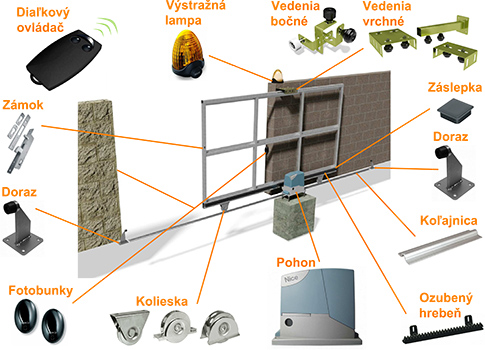
How a track-mounted sliding gate works
The main component is the gate frame, track and running wheels. Build the gate frame from closed-section, thin-wall steel profiles, which provide rigidity. The gate's running wheels are attached to the bottom of the frame (there are several mounting options; see running wheels for a track-mounted gate). These wheels allow the gate to move horizontally along the track. The track is anchored along the entire width of the opening and the full length of the gate's travel. The side guide stabilises the gate leaf and prevents it from shifting, using gate guide (top or side), which does not damage the gate's finish through friction. Gate stops are provided by bottom and top stops.
In most cases, track-mounted gates use an electromechanical operator together with safety devices (photocells, warning light). However, the gate can also be opened manually, in which case it can be locked. with a hook lock with a handle or pull handle. We offer our customers NICE gate operators because of our excellent experience with this brand.
Related links track gate
| More information: links |
|
|---|---|
|
Component kits for track gates: to make things easier, we offer complete kits containing the components needed to build a track gate. The kits are available at a discounted price. |
|
Comparing cantilever and track gates
The main difference lies in how the gate is designed to move: Cantilever gate is guided along the bottom by a C-profile that runs on two support carriages anchored outside the clear opening, whereas a track gate has wheels attached to the bottom frame profile that run along a track. Compare these options in light of the conditions on your property:
| Cantilever sliding gate | Track sliding gate | |
|---|---|---|
|
Cantilever gates are currently among the most modern and popular solutions for opening and closing an entrance to a property. Installing a cantilever gate offers the following advantages: |
Track gates are mainly used where there is not enough room for a cantilever gate. The slightly lower purchase cost of a track gate is also worth considering: |
|
|
Advantages |
» Maintenance-free operation: the lowest maintenance requirements of all gate types |
» Lower purchase price than a cantilever gate |
|
Disadvantages |
» Requires more space to slide open—approximately 30 to 40% more than the opening width |
» Requires a track with a solid foundation along the entire travel path, both across the opening and in the run-back area |
Summary: First assess each situation in terms of available space. This consideration may immediately rule out a cantilever gate, without needing to assess any other factors. Otherwise, a track gate is slightly less expensive than a cantilever gate, but requires more maintenance in winter. Some people don't mind the maintenance, while others want the convenience of opening the gate in any weather during winter. It also depends on personal preference and habits. In general, both sliding systems are very well designed; each is simply suited to a different situation.
Components for large gates
We also offer a solution for gates with a clear opening wider than 6.5 m. The components in our range can be used to build cantilever, track or swing gates with a clear opening of up to 15 m. The bottom guide C-profile for cantilever gates is also available in 140 × 140 × 6 mm, with matching carriages. We can also recommend a suitable track capable of handling the axle load of a loaded truck. Operators are also available for gates weighing up to 3500 kg (NICE TUB3500). Components for large sliding gates.
If you are interested, contact, and we will try to find a suitable solution and recommend the components you need
Two counter-sliding gates
If a sliding gate needs to cover a wide opening, consider using two gates that slide in opposite directions, each covering half of the opening. The older NICE ROBUS operators as well as the newer RBS models using the slave unit so that the two counter-sliding gates are synchronised and controlled by a single remote control.
Suspended sliding gate
Another option is a suspended sliding gate. This is a ceiling-mounted system in which a C-profile is fixed at the top of the opening. Bearing carriages run inside the C-profile, and the gate is attached to them. Our range also includes components for suspended gates:
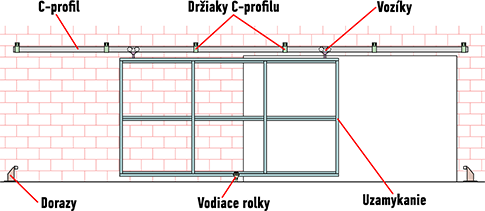
| The suspended gate system consists of the following components: | |
| Supporting section |
- C-profile is fixed to the ceiling, a beam or a wall. Three C-profile sizes are available: 34 × 31 × 2.0 mm, 42 × 52 × 2.5 mm, 57 × 67 × 3.0 mm. Choose the appropriate size based on the weight of the structure. |
|---|---|
| Guide section |
– guide rollers keep the gate from moving sideways. The use of guide rollers is shown in the diagram suspended gate guide. |
| Optional accessories |
– locks for securing the suspended gate. Standard hook locks for sliding gates |
|
See the complete range and technical information on suspended gates. |
|
Components and operators for swing gates and pedestrian gates
Whether you're building or repairing a swing gate or pedestrian gate, you'll find everything you need here, from frames and hinges to locks and operators. We're happy to help you choose parts that work well together.
Essential components for swing gates and pedestrian gates
- Structural profiles – for making gate and pedestrian-gate frames.
- Hinges – for attaching and adjusting the gate leaf.
- Locks and electric locks – for closing and locking.
- Lever handles, knobs and escutcheons and pull handles – for conveniently opening the pedestrian gate.
- Stops and keepers and drop bolts – for positioning and securing the gate leaf.
- Swing-gate operators – for automatic opening.
All components for swing gates and pedestrian gates »
For the operator comparison table and wiring preparation, see swing-gate operators.
Gate and fence infill
Match your gate's appearance to the fence and house with the right infill. Choose from six main categories:
- Aluminium slats for gate and fence infill
- Flat ZN profiles – galvanised infill profiles
- Galvanised Z-shaped slats
- FE slat system – untreated steel slats
- Stainless steel INOX slats
- WPC composite fence boards
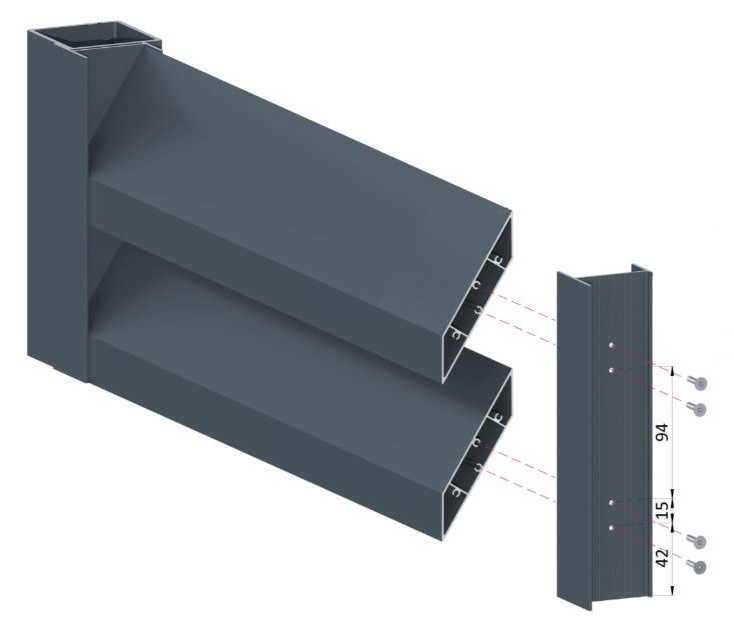
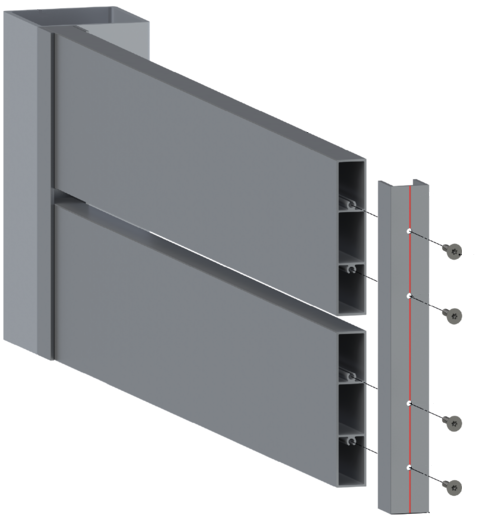
Examples of aluminium infill. The full range of aluminium slats for gates and fences is available in our store.
Find more options in our complete range of gate and fence infill.
Operators, controls and wiring
Sliding-gate operators
The operator is installed outside the opening width and is usually complemented by safety devices (photocells and a warning beacon). Choose the power supply and wiring setup to suit the specific operator. If the power fails, you can disengage the operator with a key and open the gate manually in an emergency. A properly adjusted gate mechanism ensures smooth movement, so even a child can open the gate by hand. The operator has a stop system and is secured by limit switches.
Preparing wiring for a sliding gate
When preparing the gate, remember to allow for cables to the operator, photocells, warning beacon and, if needed, the control button. Our wiring guides specify the required cables and cross-sections for each operator and control unit:
More diagrams, manuals and instructions are available on the NICE technical support. The specific cable choice also depends on cable length and the accessories used.
Choosing a gate operator
 We supply our customers with operators from the Italian brand NICE, which we use in our own installations and have been very satisfied with for many years.
We supply operators individually or in value-for-money kits that include remotes, safety photocells, a warning beacon and other accessories. The RBS400 (D), RBS600 (D) and RBS800 (D) kits include a four-channel MYGO4 remote, so you can independently control multiple compatible devices (e.g. a garage door, lighting, etc.).
When choosing an operator, consider the gate's weight and length, the number of daily opening cycles and, above all, how smoothly it moves. Our range includes operators for gates weighing up to 400, 600, 800 and 1,000 kg, as well as more powerful models. For an initial guide, we provide recommendations and operator kits with recommended accessories:
| As a general guide, we recommend up to | Operator / kit | Operator manual |
|---|---|---|
| 250 kg | NICE ROAD RD400 | NICE ROAD RD400 manual |
| 250 kg | NICE ROBUS RBS400 (D) | NICE ROBUS RBS400 manual |
| 400 kg | NICE ROBUS RBS600 (D) | NICE ROBUS RBS600 manual |
| 650 kg | NICE ROBUS RBS800 (D) | NICE ROBUS RBS800 manual |
| 700 kg | NICE ROBUS RB1000 | NICE ROBUS RB1000 manual |
| 1200 kg | NICE RUN1800 | NICE RUN1800 manual |
| 2000 kg | NICE RUN2500 | NICE RUN2500 manual |
The weights in the table are upper indicative limits of our recommendation, not the manufacturer's maximum ratings. For a long gate, a slope, frequent use or harsh winters, allow for a greater safety margin. The operator may have enough force to move the gate, but when selecting one, we also consider its service life and reliable operation in challenging conditions.
The gate's mechanical resistance is key. Even two people may struggle to move a 100 kg gate, while a well-built 500 kg gate can be moved with two fingers. It depends on the slope, the quality and correct selection of the carriages or rollers, their installation, and the guide adjustment. The gate should move easily along its entire travel path. A more powerful operator should not be used as a substitute for repairing faulty mechanics. Even when the gate moves easily, the gate's weight and length limits for the operator must be observed.
There is also a solution for gates on a slope. Depending on the slope and the specific setup, this may include a hydraulic resistance brake, which controls the gate's movement downhill. However, the brake does not replace the operator's power reserve for moving uphill.
If you're unsure, get in touch. We'll review the dimensions, weight and conditions, then select components and an operator that work well together.
Sliding gates can also be divided into residential and industrial types according to the number of openings per day. We're happy to help you choose an operator.
NICE operators for double-leaf gates
For automatic operation of double-leaf gates, we offer Wingo, Toona and HOPP kits, as well as the S-Fab and M-Fab underground operators. Selected BE2 kits include two operators, a control unit, a remote control, a pair of photocells and a flashing light. Click a kit name to see its exact contents.
The Wingo WG2024 and WG3524 kits include an MC424LR30 control unit, an INTI2 remote control, a pair of EPM photocells and an ELDC flashing light.
| Kit with photocells and flashing light | Length of one gate leaf* | Power supply | Documents |
|---|---|---|---|
| NICE Wingo WG2024 (BE2) | up to 2 m | supply: 230 V AC motors: 24 V DC | Manual |
| NICE Wingo WG3524 (BE2) | up to 3.5 m | supply: 230 V AC motors: 24 V DC | Manual |
| NICE Toona TO4024 (BE2) | up to 3 m | supply: 230 V AC motors: 24 V DC | Manual |
| NICE Toona TO5024 (BE2) | up to 5 m | supply: 230 V AC motors: 24 V DC | Manual |
| NICE Toona TO7024 (BE2) | up to 7 m | supply: 230 V AC motors: 24 V DC | Manual |
| NICE Wingo WG4000 (BE2) | up to 2 m | supply: 230 V AC motors: 230 V AC | Manual |
| NICE Wingo WG5000 (BE2) | up to 3.5 m | supply: 230 V AC motors: 230 V AC | Manual |
| NICE Toona TO4005 (BE2) | up to 3 m | supply: 230 V AC motors: 230 V AC | Manual |
| NICE Toona TO4016P (BE2) | up to 3 m | supply: 230 V AC motors: 230 V AC | Manual |
| NICE Toona TO5016P (BE2) | up to 5 m | supply: 230 V AC motors: 230 V AC | Manual |
| NICE HOPP (BE2) | up to 2.4 m | supply: 230 V AC motors: 24 V DC | Manual |
| NICE S-Fab SFAB2024 (BE2) | up to 2.3 m | supply: 230 V AC motors: 24 V DC | Manual |
| NICE M-Fab MFAB3024 (BE2) | up to 3.5 m | supply: 230 V AC motors: 24 V DC | Manual (EN) |
| NICE M-Fab MFAB3000 (BE2) | up to 3.5 m | supply: 230 V AC motors: 230 V AC | Manual (EN) |
This is only a selection of the most commonly used operators. You can find the full range of operators for swing gates in this category »
* The lengths shown are catalogue limits for a single gate leaf. Assess the permitted length and weight together, according to the limits for the specific model in the manual, for example using the Wingo chart. The maximum length and maximum weight limits do not apply at the same time. When choosing, also consider how smoothly the gate operates, the dimensions of the posts, the options for mounting the operator, and wind load, especially with solid infill.
Power supply and wiring preparation for swing gate operators
The listed kits are normally connected to a 230 V AC supply. Depending on the model, the motors themselves operate on 24 V DC or 230 V AC. On the HOPP, the control unit is built into the main HO7124 operator, which is supplied with 230 V. Prepare the cable routes in advance between the control unit, both operators, the photocells, and the warning light.
Choose the wiring according to the specific control unit and its version:
- Wingo WG2024 / WG3524 with MC424LR30 – wiring details in the current manual. Wiring diagrams are on the previous page.
- MC824H – wiring for 24 V Toona and M-Fab operators.
- MC800 – wiring shopping list for 230 V Wingo, Toona, and M-Fab operators.
- HOPP – wiring details in the operator manual.
We have separate lists for older control units: MC424LR10 (Wingo and S-Fab SFAB2024) and MC824HR10. For the S-Fab SFAB2024, choose the MC424 documentation that matches the version of the control unit supplied in the kit. Find more manuals and wiring diagrams on the NICE technical support.
Not sure which one to choose? Get in touch with the dimensions of the gate leaves and posts, an approximate weight, and a photo of the installation site. We’ll help you choose the fittings and operator.
Swing gate components and construction · Technical support and more guides
Structural profiles and profile connectors
For building gate frames, fences, and other structures, we offer box-section steel, L-, U-, and T-shaped profiles, flat bar, tubes, and mounting profiles. Choose by material:
- Galvanized steel profiles ZN
- Uncoated steel profiles FE
- Aluminum profiles AL
- Stainless steel profiles INOX
The range also includes galvanized structural and mounting profiles and profile connectors for joining tubes and box-section steel.
Technical support and advice
Technical support for NICE operators includes manuals, wiring diagrams, and solutions to common issues. For help choosing components, see our advice and help choosing components.
fortamigo.com – components, advice, and customer projects
We supply DIY enthusiasts and installation companies with quality gate components at fair prices, along with installation guides. Our aim is to help you choose the right components and successfully complete your project.
We’ll be happy to help you choose and prepare a quote. Fill in the advice and component selection form or email us at [email protected]. You can find the company details for Posuvné brány s.r.o. on the Contact page.
Your project photos and feedback are important to us. See customer reviews and the photo gallery of DIY-built gates. We’d also love to hear about your experience and see photos of your completed gate. Email them to us to inspire other DIY enthusiasts.
Find more tips in common questions about building a sliding gate. Also see the benefits of shopping at fortamigo.com.
Happy shopping and best of luck with your project from the fortamigo.com team.
Notice: The content of this website is the intellectual property of Posuvné brány s.r.o. and may be freely distributed provided it is shared in its entirety, including links, the Posuvné brány s.r.o. logo, and this notice. The content, or any part of it, may not be modified or distributed without the author's consent. To draw attention to any part of the content, link to it using a hyperlink. If any of these conditions are not met, please contact us at [email protected]. The operator manuals are an exception; they are the property of the manufacturer, Nice S.p.A. More about content protection.
Page last updated 11.9.2026