Are you planning a swing gate, or looking to add an operator? Choose your situation in the table. We’ll show you what to measure, which parts go together, and what to prepare before fabrication and concreting. Open the details directly from the relevant question.
Find the right solution for your driveway
| Your situation | Go directly to |
|---|---|
| New gate, manual for now | 4 × 1.5 m example: frame, hinges and preparation for a future operator |
| Existing gate, looking for an operator | Manual testing, measuring and choosing a kit |
| Short or sloping driveway | Space for a car · slope measurement example |
| Wide masonry pillar | Linear operator brackets or articulated arm |
| I want privacy and a solid infill | What to check when covering an existing gate |
| I’m choosing a stop or drop bolt | Finished paving, low-clearance car and the right keeper |
| I need pedestrian or emergency access | One pedestrian gate leaf · power outage |
What to measure · 4 × 1.5 m example · What to order together · Information needed for a recommendation
The 4 m × 1.5 m example is for explaining the process. Adapt the dimensions, construction and hardware to your driveway; this is not a universal fabrication drawing. Install the operator only after the completed gate has passed a manual test.
Preparation sequence: measurement → selecting the gate leaf, hardware and operator together → drawing and construction preparation → fabrication and manual testing → operator installation and commissioning.
What to measure before choosing parts
Use a tape measure to measure the finished opening between the pillars at both the top and bottom. Mark the centreline of each hinge, the finished paving level and where the car will be parked on your sketch. If the leaves are unequal, assess each one separately.
| Item | What to check on site |
|---|---|
| Clear opening | The clear distance between the finished pillars, both at ground level and at gate height. |
| Ground | The highest point along the full travel path of both leaves, not just beneath the closed gate. |
| Opening | Direction, required angle and clearance from the car, wall, fence or path. |
| Pillars | Material, condition, structural core and space for the hinge and operator bracket. |
| Gate leaves | Length from the hinge axis, finished leaf weight and infill type. |
| Operation | Manual or powered operation, wind exposure and number of opening cycles. |
A detailed guide to measuring the space and driveway slope helps identify potential collisions before fabrication.
Illustrative example: 4 m clear opening, 1.5 m frame
4,000 mm is the opening between the finished pillars; 1,500 mm is the frame height. Determine the length of each frame only after choosing the hinges, stop and any overlap. Don’t simply divide the opening into two 2-metre frames—you also need space for the hardware and operating clearances.
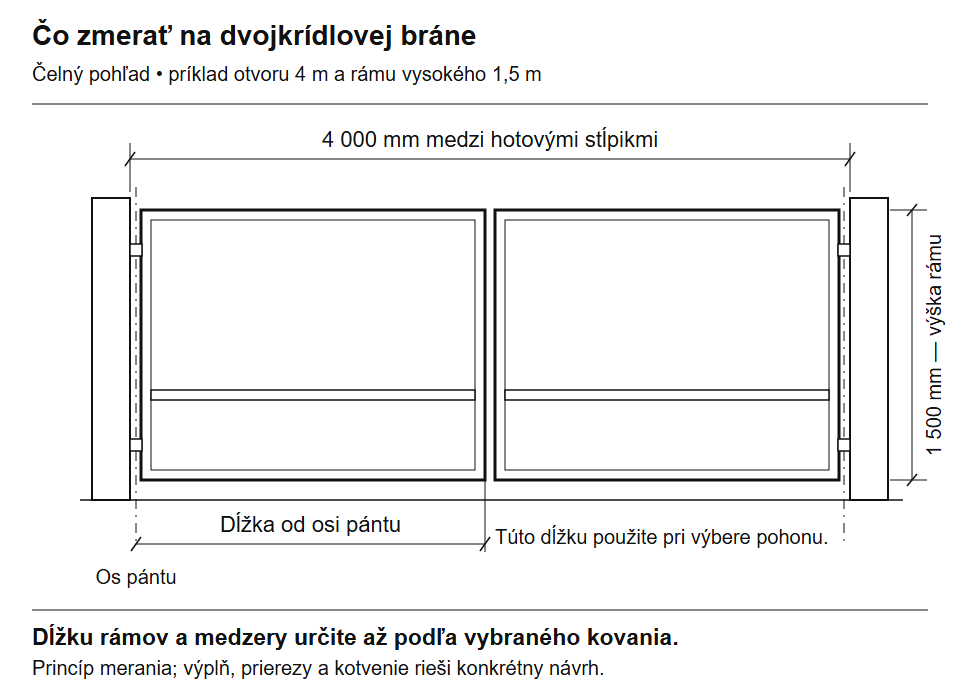
The infill is omitted for clarity. A single horizontal rail shows one possible frame layout; it does not define the cross-section or bracket position. Click to enlarge.
To choose an operator, measure the leaf from the hinge axis to its outer edge. Use the frame fabrication drawing when ordering the profiles. These are two different dimensions.
Which parts you need together
First decide how you want to operate the gate. This determines how the leaves are secured and what to include in the order.
| Your gate | Selection essentials |
|---|---|
| Manual double-leaf gate | Hinges with mounting hardware, stops and hold-open catches, drop bolt for the inactive leaf with a keeper and a lock to suit your security requirements. |
| With an operator now or later | In addition to the gate hardware, include brackets and their structural mounting points, controls, cabling and safety devices. Check the specified stops, any electric lock and emergency access. |
Compare the complete system: the price of the motor alone does not include all the necessary parts or construction preparation. For an underground operator, also check the boxes, manual release and drainage; for a manual gate, check the drop-bolt keeper and hold-open catches.
How to check what’s included in a kit and choose compatible parts
All the guides in one place
| What you need to work out | Guides and parts selection |
|---|---|
| Will the leaves fit in the driveway? | Measuring the slope, outward opening and folding leaves. Mark the travel path and the space for the car. |
| What should you build the gate from? | Frame, profiles, pillars and foundations, hinges, infill and surface protection. Choose these together with the structural mounting points for the brackets. |
| Which operator should you choose? | Operator type, 24 V or 230 V and the limits of individual models. Consider the length and weight together. |
| Will the brackets fit? | Installation geometry: Wingo A/B/C and charts, HOPP arm or underground operator. |
| What should you prepare and connect? | Cabling and MC424LR30 example. Further information manuals, installation and testing and maintenance and troubleshooting. |
| How should you secure and operate the gate? | Stops, socket with mating part, electric lock and controls and backup. Choose based on whether the gate will be operated manually or automatically. |
What to send us so we can select the parts and gate operator
For an initial recommendation, please prepare:
- A sketch of the opening, showing the length and height of each leaf, the direction of travel, and the opening angle.
- The infill type and the weight of the finished leaf; for a new gate, a list of materials so we can estimate its weight.
- Three photos: the entire entrance from the yard, a close-up of the hinge and post from above, and the area where the leaf will open. Add measurements to the close-up — a photo alone isn’t enough.
If the ground is sloped, include the surface heights along the path of the gate leaves. If an operator is already installed, also photograph its label and the control unit’s markings.
Looking for just one specific part? See hinges, latches, stops or swing gate operators. When replacing a part, also compare the installation drawing and the mating part of the original.
We’ll select the parts to suit your entrance
Send us the measurements and photos. We’ll help you compare suitable hinges, stops, and operator kits, and check that there’s enough space to install them.
| Continue with the issue you need to solve |
|---|
| Space, slope, and opening · All situations and examples |