I have limited space for a cantilever sliding gate. What are my options?
Don’t have enough room along the fence to slide a cantilever gate open? It depends on whether you’re short of space for the counterbalance tail, the entire gate leaf, or need the gate to turn around a corner as it opens. Choose the right solution based on your property.
Quick guide to choosing the right option for your property
No track across the driveway
- Not enough room for the counterbalance tail: Intelligate.
- The gate leaves need to slide alongside one another: telescopic cantilever gate.
- You have room on both sides of the entrance: two counter-sliding gates.
With a track across the driveway
- There’s room for the entire gate leaf, but not for the counterbalance tail: conventional track gate.
- You need less room to slide the gate open: telescopic track gate.
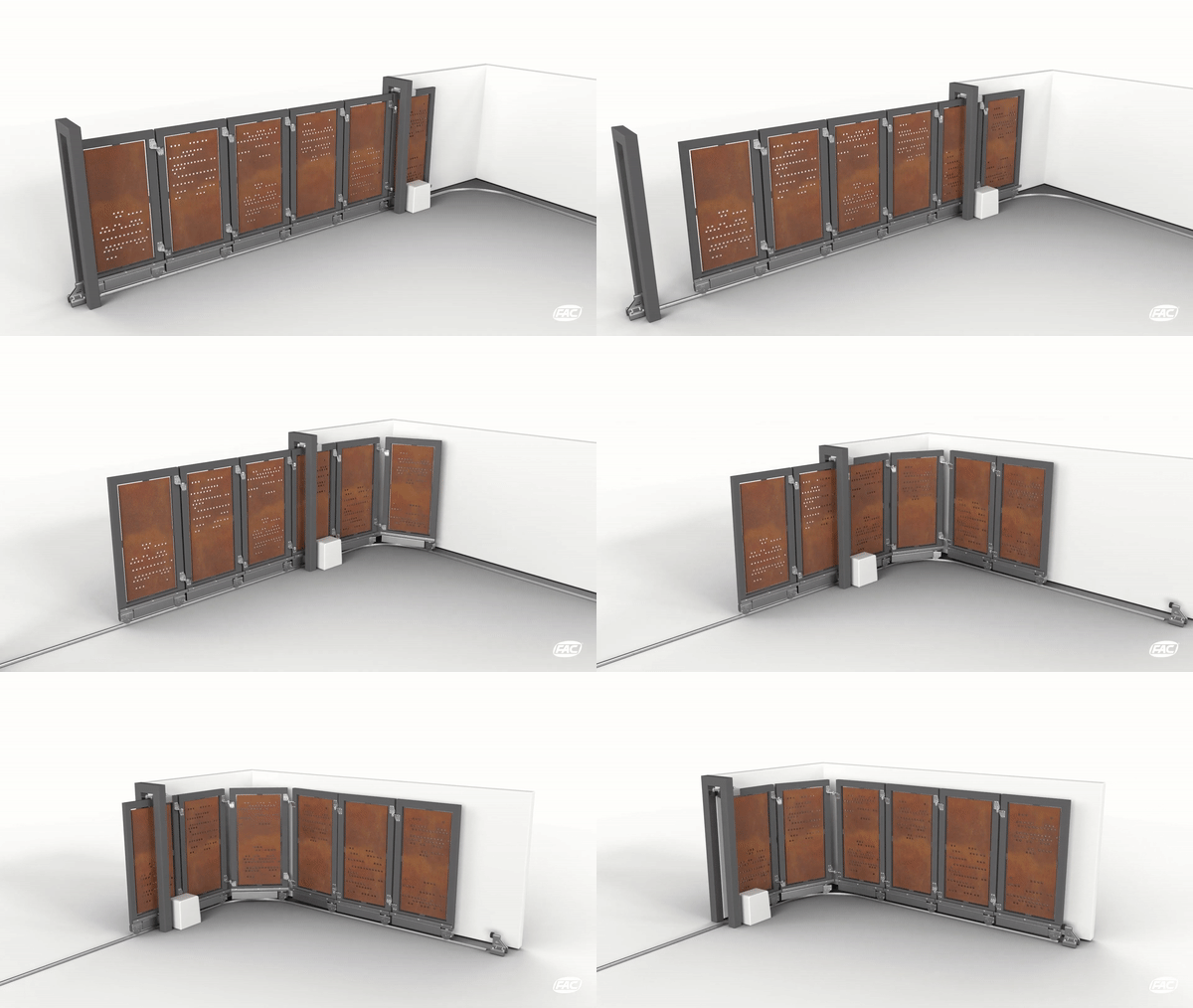
- The gate needs to turn around a corner: Radius curved gate.
Another option is to reduce the required driveway width. For an explanation of the counterbalance tail and an approximate calculation, see How much space does a conventional cantilever gate need?.
What to measure first
- Driveway width: the clear opening the gate needs to leave unobstructed when open.
- Space to slide the gate open: the distance from the edge of the driveway to the nearest obstacle. Measure both the left and right sides.
- Space alongside the fence: A telescopic gate also needs room for the leaves to stack alongside one another.
- Ground layout and surface: Mark any corners, slopes, low walls, and areas where a track could run.
Cantilever solutions with no track across the driveway
1. Intelligate cantilever gate with a short counterbalance tail
When to consider it: You want a cantilever gate but don’t have room for a standard counterbalance tail.
Intelligate uses a special telescopic track system and a different distribution of forces. This allows the cantilever gate to have a much shorter counterbalance tail while still operating without a track across the driveway.
What to bear in mind: Choose the specific configuration based on the driveway width, gate weight, and dimensions required for the gate to open fully.

2. Telescopic cantilever gate
When to consider it: You need less room to slide the gate open and want to keep the driveway free of a track.
The gate consists of two or three cantilever leaves. They move together as the gate opens and stack alongside one another on one side. This reduces the space needed compared with a conventional single-leaf cantilever gate.
What to bear in mind: You also need room for the counterbalance tails, support carriages, and the overlap between the leaves. The telescopic drive mechanism must synchronize their movement. Determine the space needed to slide the gate open from the drawing for the selected kit, not by simply dividing the driveway width by the number of leaves.
3. Two counter-sliding cantilever gates
When to consider them: You don’t have enough room on one side, but can use the space on both sides of the entrance.
The driveway is split between two cantilever gates. One slides to the left and the other to the right. When split evenly, each gate covers half of the driveway.
What to bear in mind: Each gate needs its own counterbalance tail, support carriages, and foundation. For an automated setup, choose operators that support synchronization of counter-sliding gates, and check compatibility with the specific models.
Solutions with a track across the driveway
4. Conventional track gate
When to consider it: There’s room for the entire gate leaf alongside the driveway, but not for the counterbalance tail of a cantilever gate.
The gate runs on wheels along a track, so it doesn’t need a counterbalance tail. However, the entire gate leaf still slides in a straight line when opening.
What to bear in mind: The track runs across the driveway and along the gate’s sliding path. Allow extra space beyond the gate-leaf dimensions for the guide, end stops, and installation, according to the specific design.
5. Telescopic track gate
When to consider it: You don’t have room to slide the entire gate leaf open, and a track across the driveway is acceptable.
Two, three, or four leaves slide alongside one another as the gate opens. Unlike a telescopic cantilever gate, these leaves are supported by wheels running on tracks, so they don’t need cantilever counterbalance tails.
What to bear in mind: As well as room to slide the gate open, you need space for the leaves to stack alongside one another and for their guides. More leaves can make the open stack shorter, but mean more components and a more complex installation. Determine the exact dimensions from the drawing for the selected kit.
Choose components based on the number of leaves: two-leaf, three-leaf or four-leaf telescopic track gate.
6. Radius curved track gate
When to consider it: The gate can’t slide straight along the fence, but can continue around a corner into the property.
Radius consists of several sections joined by hinges. As the gate opens, the sections follow a curved track and gradually turn around the bend. Unlike a telescopic gate, the sections don’t stack alongside one another; they follow the track one after another.
What to bear in mind: The entire path, including the curve and the space beyond it, must be clear. The track radius determines the suitable section length and the choice of wheels and guides.
7. Reducing the required driveway width
If a narrower entrance works for you, you can reduce the opening as part of the construction, for example by extending the fence. The gate will then cover a narrower opening and need less room to slide open.
Another option is to keep the opening and design a gate that does not clear it completely. In that case, allow only for the actual clear width. Neither the gate leaf nor its anchoring must obstruct the vehicle’s path through the opening.
Other common situations to consider when building a sliding gate
How much space does a conventional cantilever gate need?
A cantilever gate has, in addition to the section covering the driveway, balancing overhang. This section remains beside the opening and allows the support rollers to be positioned. The total leaf length is therefore greater than the width of the opening itself.
The overhang and the distance between the rollers affect the load on the support system and how smoothly the gate runs. Choose their dimensions based on the fittings used, the opening width, the gate’s weight and its construction. A more powerful operator alone will not solve a poorly designed mechanism.
Example for a 4 m opening: with a coefficient of 1.4 and an additional 0.2 m, the total leaf length is 4 m × 1.4 + 0.2 m = 5.8 m. This is an illustrative calculation for a standard cantilever gate, not an installation dimension for every configuration. Do not apply it to Intelligate or telescopic systems.
Before manufacturing, compare the available space with the drawing for the specific kit. Allow for overlap at the posts, the guide system, stops and the operator.
We’ll help you choose the right solution
Prepare a sketch showing the opening width, the space available on both sides and any obstacles. If you know it, include a photo of the entrance, the planned infill and the approximate weight of the gate. With this information, we can compare suitable systems and the components you’ll need.
Email: [email protected]
Phone: