How to Choose Gate Components 4 Main Criteria
Complete guide to sliding gate components
It’s easy for a newcomer to get lost in the range of gate components. C-profiles, rollers, end stops, stops and guides everywhere. Our online shop offers more than 2,000 products, but in this article we’ll show you that choosing the right components is nothing complicated.
Cantilever sliding gate
A cantilever gate is built around support carriages, along which the guide C-profile runs. One end of the C-profile is covered by an end cap, while the other has a guide roller that directs the gate into the receiving stop.
The top of the gate is held in place by an upper guide, and an upper stop can also be fitted above the receiving stop. Stops help secure the gate when closed and relieve the support carriages, so they don’t have to bear the gate’s full weight.
Additional accessories include locks, handles and pull handles. A cantilever gate is typically secured with a hook lock, which engages with the gate post.
| Components for a cantilever gate | Detail | ||
|---|---|---|---|
 |
Support carriage for a cantilever gate | Detail  |
|
|
Carriages can be classified by wheel material: nylon, steel or stainless steel; number of wheels: 3, 5, 8, 10; pivoting action: pivoting/fixed; and height adjustment: adjustable/non-adjustable |
|||
 |
C-profile for a cantilever gate | Detail |
|
|
Choose the C-profile by size: 60x60, 70x70, 80x80, 100x100, 140x140; material and finish: standard steel, galvanized steel, stainless steel; and length: from 1 to 6 metres. |
|||
 |
Bottom guide roller for a cantilever gate | Detail |
|
|
Choose the guide roller according to the C-profile size. These components are compatible with one another. |
|||
 |
Bottom stop for a cantilever gate | Detail |
|
|
Choose the stop according to the C-profile size. These components are compatible with one another. |
|||
 |
Upper stop for a cantilever gate | Detail |
|
|
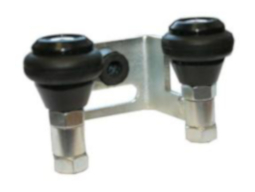
Upper stops improve gate stability. They are generally selected according to the gate width at the top. |
|||
 |
Gate guide | Detail |
|
|
A gate guide provides vertical stability and prevents sideways movement. You can choose an upper or side guide, depending on the installation layout. |
|||
 |
Metal C-profile end cap | Detail |
|
|
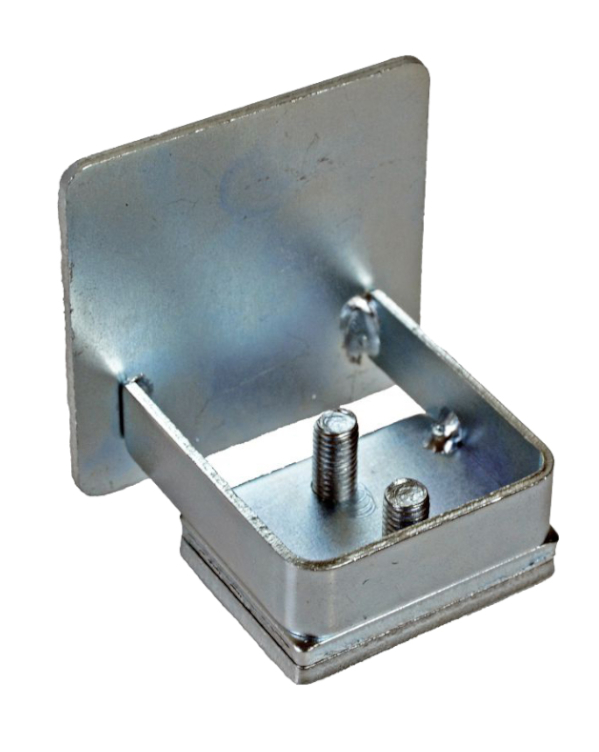
Choose the end cap for covering the C-profile according to the C-profile size. These components are compatible with one another. |
|||
Track sliding gate
As the name suggests, a track gate requires a track and wheels. We offer tracks and matching wheels in two shapes: U-shaped and V-shaped. U-shaped tracks have a semicircular groove with a diameter of 16mm or 20mm, while V-shaped tracks have a 90° groove.
We offer wheels for these tracks in various sizes and with different mounting options. The wheels can be bolted or welded to the underside of the gate.
Other important components of a track gate are the stop and the guide. Whether at the bottom or top, a stop is needed to prevent the gate from coming off the track. The gate guide holds the top of the gate in place and helps it move straight.
Locks, handles and pull handles are also important. For a track gate, we also recommend a hook lock, but it must be fitted with a locking pin to prevent the gate from being lifted and opened.
| Components for a track gate | Detail | ||
|---|---|---|---|
 |
Gate track | Detail |
|
|
Tracks are classified by shape: U-shaped/V-shaped; length: from 1 to 6 metres; material and finish: galvanized/stainless steel; and mounting method: for bolting or direct casting into concrete |
|||
 |
Gate wheels | Detail |
|
|
Wheels are primarily classified by the shape of the matching track, which they run on: U-shaped/V-shaped. They are also classified by mounting options: bolt-on with bracket/recessed bolt-on/recessed weld-on/standalone wheel; material and finish: galvanized/stainless steel; and wheel diameter: 60/80/90/100 mm. |
|||
 |
Gate bottom stop | Detail |
|
|
The bottom stop is an optional component, but it is included in our kits. The stop can be bottom or top and is used to stop the gate at its end position. |
|||
|
Gate guide | Detail |
|
|
A gate guide provides lateral stability for the gate in the vertical plane. You can choose a top or side guide, depending on the layout. |
|||
Suspended sliding gate
The name of a suspended gate is also derived from how the gate works. The load-bearing C-profile is suspended from the top of the structure. Guide trolleys run inside it, and the gate itself is attached to them.
Stops are also needed to bring the gate to a halt, along with guide rollers, which in this case are mounted on the ground.
This type of gate is used as a sliding partition, sliding door or warehouse entrance gate, or in other places where you want a sliding gate but a cantilever or track-mounted gate is unsuitable.
For the suspended system, we adopted the size designations used by our supplier, so most suspended-gate products are grouped by size as picollo, medio and grande.
| Components for a suspended gate | Detail | ||
|---|---|---|---|
 |
C-profiles for suspended gates | Detail |
|
|
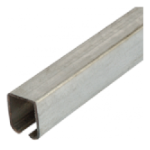
Guide C-profiles for suspended gates differ from the C-profiles used for cantilever gates. They are distinguished mainly by their smaller dimensions and lower weight. Choose a C-profile for a suspended gate based on its size: picollo/medio/grande; length: from 1 to 6 metres; and finish: galvanised/stainless steel. |
|||
 |
Trolleys for suspended gates | Detail |
|
|
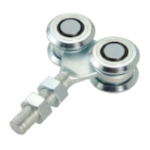
Guide trolleys are also categorised first by size (to match the corresponding C-profile): picollo/medio/grande. They are further categorised by number of rollers: 2/4; roller material: metal/nylon; and trolley material: metal/stainless steel. |
|||
 |
C-profile brackets | Detail |
|
|
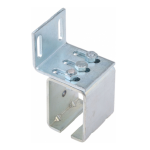
C-profile brackets are also categorised first by size (to match the corresponding C-profile): picollo/medio/grande; and mounting method: side-mount/top-mount. |
|||
|
Gate bottom stop | Detail |
|
|
The stop can be bottom or top and is used to stop the gate at its end position. |
|||
 |
Guide rollers | Detail |
|
|
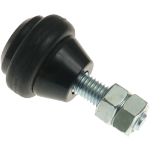
A gate guide provides lateral stability for the gate in the vertical plane. On a suspended gate, the guide mechanism is at the top, so guidance is needed at the bottom. Ground-anchored rollers are sufficient for this purpose. |
|||
How to choose components for a sliding gate
We have briefly explained the components, but how do you choose the right components for a sliding gate?
- Clear opening width + total space available for the gate
- Gate weight
- Gate material (Fe, Zn, Inox)
- With or without an operator
Once you have these four points clear, choosing the right components takes just a few minutes. You can choose a ready-made kit based on the clear opening width and gate weight, or give us a call and we’ll be happy to advise you.